Reverse-Engineering BASED’s RNG because I wanted 1st on the speedrun leaderboard
Based on what?
BASED is a quaint little game about performing platform-fighter attacks to combo the moon into the sky.
A couple of weeks ago I played through the demo, liked how smooth the game felt, and decided to try speedrunning it. As the demo of a small indie game, I figured the speedrunning scene would be basically nonexistent — and a look at its speedrun.com page confirmed it: nearly every category had three runs or fewer. Easy #1, I figured. So I recorded a handful of runs for Sword Any%, submitted them, and all was well.
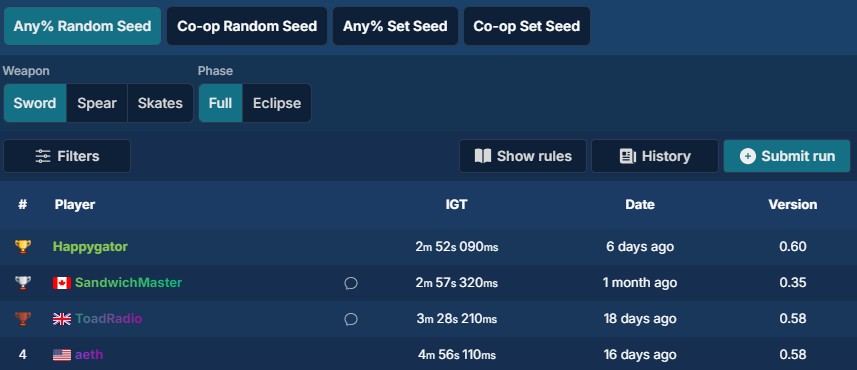
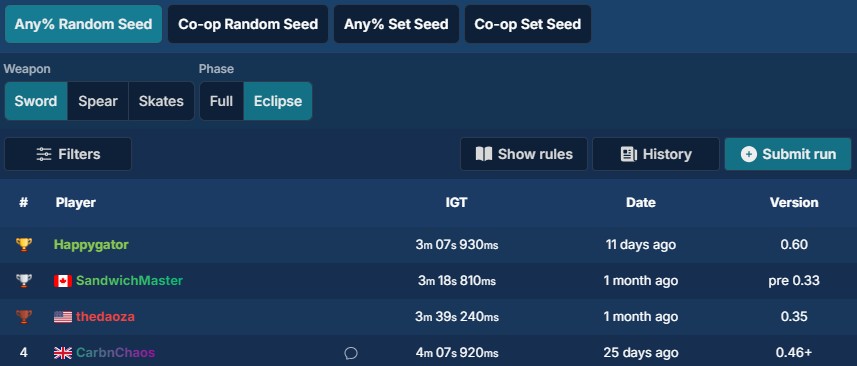

I’m technically a world record holder now. Yippee!
They’ve also got a category for Set Seed, and the game’s Discord said their next goal was any sub-2:50 time. I made a handful of mistakes in my Full Moon Any% run, but the seed was pretty good and I still managed a 2:52 — so let me just record another run without those mistakes and submit it!
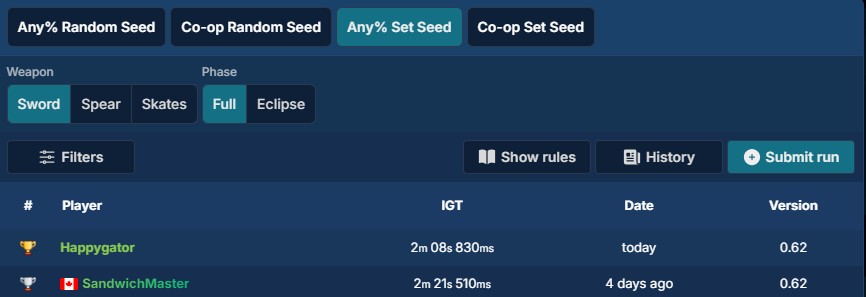
I come back to the speedrun leaderboard to find my day ruined.


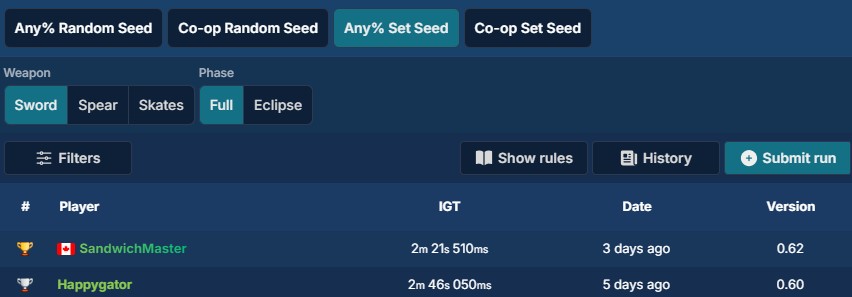
Second place? How? That guy’s time is so much faster than mine!

My live reaction to this information.
I watch his run, and discover that the seed he used is way better than mine. SandwichMaster rolls fast room after fast room in his run and gets to perform tons of skips that I couldn’t in my run, which used just an “above average” seed that I found by just playing a bunch of runs.
Everything’s fine though! I’ll just copy the seed from his video, be slightly faster on his movement, and resubmit to get 1st back!

But what if he comes back, having done it slightly faster than I did? Even worse, what if he comes back with a new run on a different seed? I’ll have to copy and play that seed again to catch up!
I come to the conclusion that I’m going to need to find seeds myself until I can roll up to the leaderboard with something that won’t be easily beaten. No problem, I’ll just play a bunch of random seed runs until I find one with similar luck. Each lucky floor saves around 5 seconds but is roughly 10x rarer, his time was around 25 seconds faster than mine, and I can expect to shave 5+ seconds off by moving better, so finding a better seed will only take, uhhh…
| What do I need? | How many runs? | How long? |
|---|---|---|
| Any average run | 1 | ~3:15 |
| 1 extra lucky floor | ~10 | ~30 minutes |
| 2 extra lucky floors | ~100 | ~5 hours |
| 3 extra lucky floors | ~1,000 | ~2 days |
| 4 extra lucky floors (roughly where I estimated SandwichMaster’s seed was) | ~10,000 | ~3 weeks |
| A seed that beats that seed | ~100,000 | ~7 months |

Why am I going through the game and playing every seed anyways? If I knew how the game turns seeds into rooms, I could just build a seeder script that scans seeds for me and gives me the fastest ones!
Seeder? I hardly know 'er!
Nothing in a video game is truly random.[1] When BASED needs to decide which rooms you’ll play through, which powerup appears on each floor, and what enemies spawn, it’s running a fixed formula that produces a fixed sequence of numbers. The single input to that formula is called the seed.[2]
A BASED run is 20 floors (19 are random, and floor 20 is always the predetermined goal room), and the seed fixes all of it in advance — the room on each floor, the powerup orb that floor hands you, and which enemies show up. Type in seed 1 and you get exactly the same 20-floor layout as everyone else who has ever typed 1.
That total reproducibility is the whole basis of a Set Seed run: with luck out of the picture, timesaves are found on raw execution.
Which points straight at the obvious question. If a run is completely determined by its seed before it even begins, could you work out what a seed will throw at you without playing it or, better yet, go hunting through every possible seed for the single fastest run in the game?
How can I automate getting the fastest seeds?
Answering that meant figuring out exactly how BASED turns a seed into a run — every room, every powerup, every enemy — and then rebuilding that whole process outside the game so I could run it thousands of times a second. Here’s roughly how that went.
The game is built in Unity

The first lucky break is that BASED is built in Unity, which means the game’s logic ships as compiled C# - ordinary .NET assemblies (.dll files) sitting right there in the game folder. C# doesn’t compile down to inscrutable machine code the way a C++ game would; it compiles to a bytecode that decompiles back into almost-readable C# source. So instead of squinting at raw assembly, I could essentially read the developers’ own code. I used a tool called AssetRipper: point it at the game and it spits out everything I could possibly need.
Finding the actual dice-roller
Digging through the decompiled Core.dll, the random-number generator turned out to be simple enough: a little class that holds a single integer — call it the counter — and, every time the game wants a random number, bumps that counter by one and runs it through a small hashing function.[3] The seed you type just gets hashed once to decide where the counter starts. Right next to it were the classes that actually use those numbers: the map generator that picks rooms, the bit that rolls powerups, and the enemy spawner.
Rewriting it in Python
Once I could read the code, I re-implemented the whole chain in Python so I could run it without launching the game. C# does arithmetic in ways Python doesn’t, and I needed my version to spit out the exact same numbers, down to the last bit, or the predictions would drift off course. C# integers silently wrap around when they overflow; its rounding breaks ties toward even numbers; the string-hashing quietly mangles capital letters and strips spaces before it even starts. Missing any one of those screws the entire seed prediction, so a good chunk of the work was just chasing down and matching those quirks.
Checking it against reality. None of this is worth anything if it doesn’t match the real game, so I recorded an actual run on seed 1 and compared it floor-by-floor against my predictor. It immediately caught two honest bugs — an off-by-one in how floors are counted, and a case where I had the room list in the wrong order — but once those were fixed, it nailed all 20 floors: every room, every powerup, and every enemy, exactly.
So how does the RNG actually work?
With all of that pieced together, the whole system is short enough to describe in three steps:
-
Your seed becomes a single number. The game takes the seed you typed, cleans it up (uppercases it, throws away spaces and invisible characters), and hashes it down to one 32-bit integer — the counter. From that point on, your original text is never looked at again. Two different seeds that happen to hash to the same number produce identical runs.
-
The counter becomes a stream of “random” numbers. Whenever the game needs a roll, it nudges the counter up by one and mixes it through a fixed hash to get the next value, then squeezes that into whatever range it needs — a difficulty level, a pick from a list, a yes/no chance. Since every value is just a hash of the counter, there’s no real randomness hiding anywhere: the counter’s current value tells you everything.
-
Those numbers become your run. The game keeps a few of these counters going in parallel and draws from them to choose each floor’s room (from a filtered list that avoids recent repeats), its powerup, and its enemies (with an extra difficulty setting you pick in the lobby). Stack 20 floors of that up and you’ve got a full run.
And here’s the punchline that kicked off this entire project: because a run is nothing more than a function of one 32-bit number, there are only about 4.3 billion[4] possible runs in the whole game — and typing a seed is just a way of landing on one of them, more or less at random. 4.3 billion sounds enormous, but to a computer it’s small enough to grind through every single one and pick out the outright fastest run that exists. Which is exactly what I set out to do.
How can I find a good seed to run?
With these tools, I could take any seed and print its entire run without ever opening the game, but knowing what a run contains still isn’t the same as knowing whether it’s fast. To actually hunt for the best one, I needed two more things: a way to score a run, and a way to search without checking billions of seeds by hand.
Putting a time on a run
A seed’s rooms and powerups are locked in the moment you know it, but how fast that run can be played still takes some figuring out. Every room takes some baseline time to clear, but the powerups bend that number all over the place: the right movement ability on the right floor lets you skip a huge chunk of it, carry momentum from one room into the next, or blow past an obstacle that would otherwise cost you seconds. So on top of the predictor I wrote a small optimizer: hand it a seed’s 20 rooms and its powerups out, and it works out the fastest possible way to play that exact sequence, then hands back a single number — this seed’s best-case time. With that, any two seeds can be compared head-to-head, and a “good” seed is simply one with a small number.
Why you can’t just check every seed
The obvious plan is to loop over seeds — 1, 2, 3, and so on — score each one, and keep the best. The trouble is baked into how seeds work: the string you type doesn’t matter, only the 32-bit number it hashes to. Marching through seed strings just flings you randomly across those 4.3 billion numbers — you keep landing on ones you’ve already seen (wasted work), skip over enormous stretches you never check at all, and to be even halfway sure you’d found the best run you’d have to grind through tens of billions of strings and still couldn’t prove it. And I didn’t just want a good seed; I wanted to know I’d set a bar nobody could easily beat. Random sampling can never give you that.
A revised approach
Since a run depends only on the 32-bit number the seed hashes to, I can ignore seed strings entirely and just march through the numbers themselves — 0, 1, 2, all the way up to 4.3 billion. Each one is a distinct possible run, with no duplicates and no gaps, so if I compute the best-case time for every number and store it in one enormous table, I’m no longer sampling anything: I’ve got the fastest time for every run the game can possibly produce. The catch is that the game won’t let you type one of those numbers — it only takes a seed string, which it then hashes. So once the table points me at the winning number, I have to run the whole thing backward and dig up a seed string that hashes to exactly that value. The hash can’t be reversed, so this is its own brute-force search — try strings until one lands on the target — but because the hash sprays strings roughly evenly across all 4.3 billion possibilities, any particular target is reachable with decent odds inside a few billion tries (roughly a 63% chance by the time you’ve tried 4.3 billion of them). All I have to do is find an appropriate string and type it in.

While the script runs, I can get down to important business like lying around and doing nothing.
Did it work?
As a first pass I scanned just the first 200 million seeds — well under 5% of the 4.3 billion. I found many seeds that were promising, but focused on hash code 17771233, which happened to stack several fast rooms and had room for some experimental high-speed tech.[5]
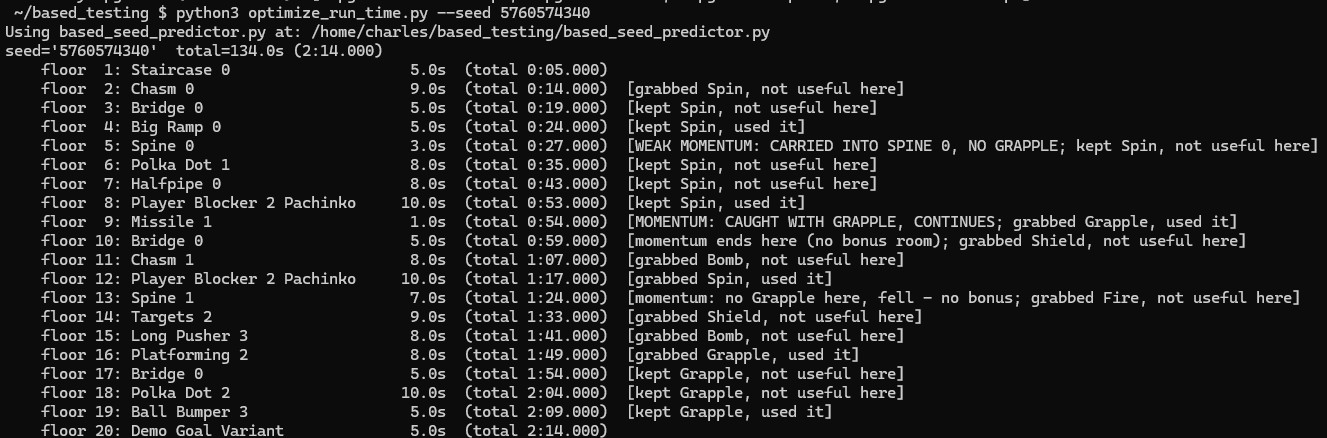
That’s a hash index, though, not something the game lets you type. So I ran the reverse search and turned up a seed string that hashes straight to it: 5760574340. I played it start to finish once just to confirm the run was actually real — that the rooms, powerups, and skips lined up exactly the way the predictor claimed — and they did.
After that it was pure execution, and I ran the seed over and over until I was satisfied. The result was a 2:08[6], which you can watch here.
That’s more than ten seconds under the previous record — and more than enough to take my spot back.
Victory.
What’s next?
If I could manually rig every floor and powerup, this is what I’d run:
| Floor | Difficulty | Room | Powerup | Time |
|---|---|---|---|---|
| 1 | 0 | Big Ramp 0 | Spin | 5s |
| 2 | 0 | Spine 0 | Grapple | 1s |
| 3 | 1 | Bridge 0 | — | 5s |
| 4 | 0 | Staircase 0 | — | 5s |
| 5 | 0 | Button Vertical Gate 0 | Fire | 4s |
| 6 | 1 | Hittable Walls 1 | Fire † | 6s |
| 7 | 1 | Bridge 0 | — | 5s |
| 8 | 2 | Player Blocker 2 Pachinko | Spin | 10s |
| 9 | 1 | Missile 1 ‡ | Grapple | 1s |
| 10 | 1 | Ball Bumper 1 | — | 7s |
| 11 | 2 | Blocks 2 | Fire | 6s |
| 12 | 2 | Chasm 1 | — | 8s |
| 13 | 1 | Spine 1 | — | 7s |
| 14 | 2 | Player Blocker 2 Pachinko | Spin | 10s |
| 15 | 3 | Ball Bumper 3 ‡ | Grapple | 1s |
| 16 | 2 | Chasm 1 | — | 8s |
| 17 | 1 | Spine 1 | — | 7s |
| 18 | 2 | Player Blocker 2 Pachinko | Spin | 10s |
| 19 | 3 | Ball Bumper 3 ‡ | Grapple | 1s |
| 20 | — | Goal | — | 5s |
| Total | 112s |
- † Uses a second banked Fire, not this floor’s own orb.
- ‡ Momentum carried in from the previous Player Blocker 2 Pachinko (Spin) — with Grapple, the room clears in a single second.
Each room is slightly over-estimated, so flawless movement would likely put the final time at around 105s, or 1:45.
Obviously, such a miraculous seed likely doesn’t exist, but grinding through the full space will find the real, typeable seed that gets as close to it as the RNG will allow. I expect that a seed exists that can reach sub-2:00, but each timesave is exponentially sparser than the last.[7]
Hilariously, rigging set seeds can theoretically work for the random seed category. The seed the game “randomly” uses is equivalent to the number of milliseconds that your computer has been on, meaning that pressing the “Create Lobby” button in the main menu at the right time could roll any (feasibly reachable) seed and guarantee an impossibly fast time. If you fail, though, you have to reboot your computer to try again, resulting in possibly the single worst speedrun strategy I’ve ever seen.
Strictly speaking, computers can’t cook up true randomness on their own — they’re deterministic machines that do exactly what they’re told. To fake it convincingly, they seed their “randomness” from things that are miserable to predict: the exact sub-millisecond timing of your keystrokes and mouse jitters, noisy hardware and environment readings, or — famously — the wall of lava lamps that Cloudflare films and feeds into the randomness behind a big slice of the internet’s encryption. BASED skips all of that and just starts from a number to enable setting seeds for runs. ↩︎
To be clear, this is a deliberate design choice, and a completely standard one. Seeding a game’s randomness from a single value is exactly what lets games offer reproducible, shareable runs: daily challenges, Set Seed races, “try this seed” links. Many other games have some degree of randomness(Balatro, Slay the Spire come to mind) and base it off a seed. Everything in this writeup just leans on that intended reproducibility. ↩︎
A hash function is a bit of math that takes any input and scrambles it into a fixed-size number. The same input always produces the same output, but the output looks random, changing the input even slightly scrambles it completely, and there’s no practical way to run it backwards from the number to whatever produced it. ↩︎
Precisely 4,294,967,296, or 2³², for an unsigned 32 bit integer. My favorite number is roughly half that, at 2,147,483,647! (not a factorial I know you’re waiting to make that joke) ↩︎
Using the Spin powerup in certain rooms flings the moon straight up outrageously fast. If you find and use the Grapple (grappling hook) powerup right after, you can hook onto the launched moon and catch up to it, blitzing through some rooms almost instantly. This was not used in any other run on the leaderboard because only about 1% of seeds line up everything(finding the room, finding Spin, finding a suitable followup room, finding Grapple in that room) to do this, and it’s only kinda fast so the rest of the seed still has to be near-perfect. ↩︎
The real run beat the estimated “best case time” of 2:14 for two reasons: I found a few extra timesaves while grinding attempts, and every room’s time estimate is deliberately rounded up, so the predicted total always leans a little pessimistic. ↩︎
A run only gets faster when more of its floors happen to roll their ideal room-and-powerup at once, and each floor lining up perfectly is a roughly independent long shot. Demanding one more perfect floor multiplies the rarity: if a single good floor turns up in, say, 1 of every 10 seeds, two good floors is roughly 1 in 100, three is 1 in 1,000, and so on. Since each set of 1-4 seconds shaved off needs roughly one more floor or powerup to fall into place, the seeds that deliver it get exponentially rarer, to the point that a seed that has truly everything perfect almost certainly doesn’t exist in the “only” 4 billion possible hash values. ↩︎